
Designing Trust: Why Visual Identity Matters for Citizen Science Infrastructure
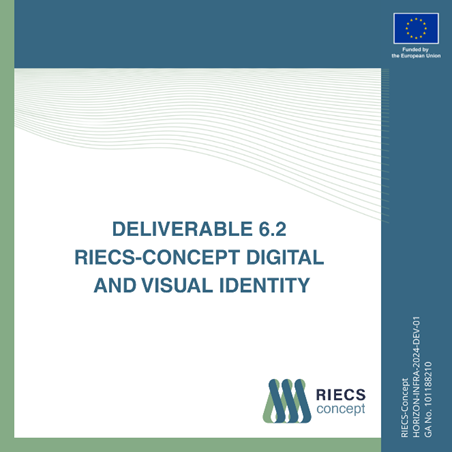
📢 Citizen science is often discussed in terms of data, participation, and impact. Yet one critical dimension is frequently underestimated: how such initiatives are seen.
✳️ As citizen science scales toward a coordinated European Research Infrastructure, visibility is no longer cosmetic; it becomes structural.
✳️ Deliverable 6.2 of the RIECS-Concept project shifts attention precisely to this layer. It asks a deceptively simple question: how can a coherent digital and visual identity contribute to building a pan-European infrastructure for citizen science?
✨ The answer is clear: design is not decoration. It is alignment. ✨

From Fragmentation to Recognition
✳️ Citizen science in Europe is inherently diverse. It spans disciplines, communities, and institutional contexts. This diversity is a strength, but also a challenge. Without a shared visual language, initiatives risk appearing fragmented, temporary, or disconnected.
✳️ RIECS-Concept addresses this through a unified visual identity system. The goal is not aesthetic uniformity, but recognisability across contexts: reports, presentations, digital platforms, and public-facing materials. A consistent identity enables stakeholders to immediately associate outputs with a credible, coordinated European effort.
✨ In infrastructure terms, this is about signal coherence. Visibility becomes a mechanism for trust-building. ✨

Visual Identity as a Reflection of Values
✳️ The RIECS-Concept identity is not arbitrary. It is explicitly designed to reflect core principles of citizen science: inclusiveness, collaboration, sustainability, and integration.
✳️ The logo itself embodies this logic. Interconnected geometric forms symbolise networks, data flows, and community participation. The repetition of abstract human-like figures suggests collective action, reinforcing the idea that infrastructure is built with citizens, not merely for them.
✳️ Colour choices align with sustainability and environmental awareness, while typography prioritises accessibility. Helvetica – selected for readability and ubiquity – ensures that communication remains inclusive, including for audiences with visual impairments.
✨ This is designed as semiotics: every element communicates institutional intent ✨

Communication Tools as Infrastructure Components
✳️ Deliverable 6.2 goes beyond branding guidelines. It establishes a full ecosystem of communication tools – templates, layouts, and digital assets – that function as operational infrastructure.
📌 These include:
⚫ Standardised deliverable and presentation templates.
⚫ Letterheads for formal and semi-formal communication.
⚫ Roll-up banners for physical visibility at events.
⚫Digital banners and icons for online dissemination.
A structured and evolving project website.
📌 Each element reduces friction in communication workflows while ensuring consistency across partners. In distributed, multi-actor projects, such standardisation is essential. It enables decentralised production of materials without compromising coherence.
✨ In practical terms, this is a modular communication architecture ✨
✳️ At the centre of the digital identity is the project website: a living platform designed to evolve alongside the infrastructure itself.

The Website as a Dynamic Knowledge Hub
📌 It serves multiple functions:
⚫ A repository of outputs and deliverables.
⚫A gateway for stakeholder engagement and co-creation.
⚫A dissemination channel for news, events, and publications.
⚫ A long-term digital archive beyond the project lifecycle.
✳️ Crucially, the website is designed with accessibility and inclusivity in mind. Clear navigation, contrasting colours, and multilingual considerations ensure that diverse audiences can engage effectively.
✨ This reflects a broader principle: infrastructure must be usable to be meaningful ✨

Social Media as Distributed Outreach Infrastructure
✳️ RIECS-Concept strategically deploys multiple social media platforms – LinkedIn, Facebook, Instagram, X, and Bluesky – to reach different audience segments.
✳️ Rather than treating these channels as optional add-ons, the project integrates them into its dissemination logic. Each platform becomes a node in a distributed communication network, amplifying visibility and engagement across stakeholder groups.
✨ The implication is clear: in contemporary research ecosystems, infrastructure extends into digital publics ✨

Ethics, Inclusivity, and Sustainability by Design
✳️ The visual identity is explicitly aligned with ethical and societal considerations. Inclusivity is embedded across multiple dimensions – gender, language, accessibility, and socio-economic diversity.
✳️ Even material production reflects sustainability principles. The balance between digital and printed outputs, along with recommendations for eco-friendly materials, ensures that communication practices align with environmental values.
✨ This integration is critical. Infrastructure that aspires to legitimacy must reflect the values it promotes – not only in outcomes, but in processes ✨

Consistency as a Precondition for Impact
✳️ A recurring challenge in EU-funded projects is the fragmentation of outputs. Deliverables exist, but their visibility and long-term usability remain limited.
📌 RIECS-Concept addresses this by embedding consistency at every level:
⚫ Visual coherence across materials.
⚫ Standardised acknowledgement of EU funding.
⚫ Clear integration of partner identities.
⚫ Centralised access through the website.
✨ These practices ensure that outputs are not only produced, but recognised, trusted, and reused ✨

Designing for a Shared European Future
✳️ Ultimately, Deliverable 6.2 demonstrates that building a European Research Infrastructure for Citizen Science is not solely a technical or organisational task.
✳️ RIECS-Concept positions visual and digital identity not as an auxiliary layer, but as a foundational component of infrastructure development. It transforms design into a strategic tool – one that aligns actors, communicates values, and supports systemic integration.
✨ In doing so, it makes a compelling case: if citizen science is to become a durable pillar of the European Research Area, it must not only function as infrastructure, it must look and feel like one ✨
🔗 More information can be found here: https://concept.riecs.eu/deliverables/
Published: 2026-04-15