

New Article “Why Citizen Science Is Now Essential for Official Statistics”
📢 We are pleased to share that a new article, “Why Citizen Science is Now Essential for Official Statistics“(authors: Dilek Fraisl, Linda See, Steve MacFeely, Inian Moorthy, Georges-Simon Ulrich, Omar Seidu, François Grey, Samuel Schütz & Ian McCallum) has been published in Nature Communications Sustainability❗
✳️ The paper acknowledges the RIECS-Concept and represents a major collaborative effort between researchers and senior leaders from the global official statistics community.
✳️ Alongside the IIASA and CSGP RIECS-Concept teams, the article is co-authored by the Chief Statistician of the OECD, the Director-General of the Swiss Federal Statistical Office (FSO) and the Chair of the UN Statistical Commission, the Head of Social Statistics & Coordinator of Data for SDGs at the Ghana Statistical Service (GSS), RIECS-Concept Advisory Group member François Grey, as well as the Strategy Expert at FSO. ✨ This breadth of authorship reflects the growing recognition that citizen science has reached a turning point in its relationship with official statistics.

A global data crisis
✳️ The article responds to an emerging and urgent challenge. In February 2025, the termination of the Demographic and Health Surveys, one of the most important sources of population, health, HIV, and nutrition data for more than 90 countries, long supported by the United States Agency for International Development, constitutes a crisis for official statistics.
⚫ The consequences are particularly severe for low- and middle-income countries that lack the resources and infrastructure to run large-scale national surveys independently.
⚫ At the same time, proposed cuts to environmental monitoring agencies in high-income countries are weakening the global capacity to track environmental change and progress toward the Sustainable Development Goals.
✨ Together, these developments expose the fragility of existing data systems at precisely the moment when timely, granular, and trusted data are most needed.

Citizen science as a core component of official statistics
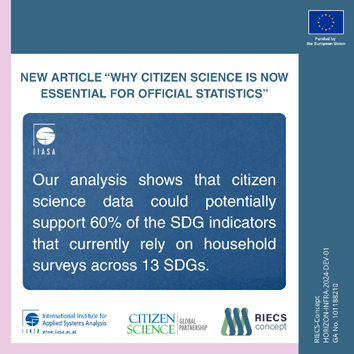
✅ The central argument of the paper is clear: citizen science is no longer a supplementary or experimental data source. The analysis shows that citizen science data could potentially support 48 indicators, around 60% of those that currently rely on household surveys across 13 SDGs.
✨ This is not a marginal contribution; it represents a substantial opportunity to strengthen statistical systems under pressure.
✳️ Yet official statistics and policy communities have historically viewed citizen science with caution, often citing concerns around data quality, representativeness, and standardisation.
✳️ While these concerns are valid, the evidence now shows that they are increasingly addressable through robust methodologies, validation frameworks, and institutional partnerships.

A necessary shift in perspective
🔑 To unlock this potential, a fundamental shift in mindset is required. Data generated voluntarily by the public – when properly designed, governed, and integrated – should be recognised as an essential contribution to official statistics.
✨ Embracing citizen science does not mean abandoning traditional surveys or environmental monitoring. On the contrary, it requires continued investment in official data infrastructures, alongside strategic investment in citizen science to create more adaptive, inclusive, and resilient systems. In an era of political, financial, and environmental uncertainty, flexibility is no longer optional; it is a prerequisite for sustainable statistics.✨
🔗 The full article can be read here: https://www.nature.com/articles/s44458-025-00008-4
Published 2026-01-14