
From Awareness to Action: Living Labs and Citizens’ Assemblies in Climate Adaptation
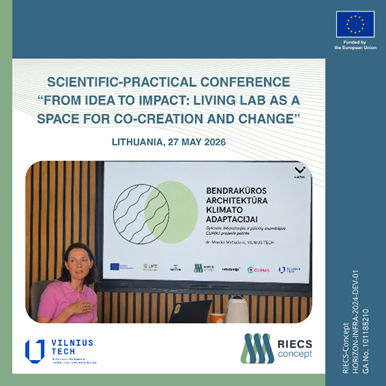
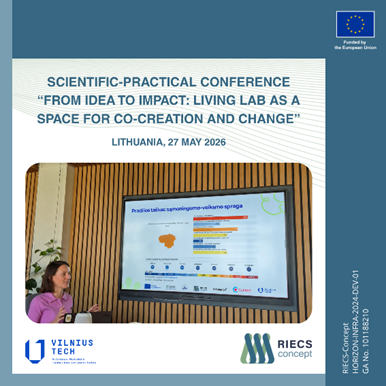
📢 On 27 May 2026, researchers, practitioners, public institutions and community representatives gathered at the VILNIUS TECH Sustainability Hub for the scientific-practical conference “From Idea to Impact: Living Lab as a Space for Co-Creation and Change”, organised by the National Living Labs Network (LLLNet) together with partner institutions❗
✨ The conference focused on the methodological foundations of Living Labs, participatory innovation and long-term collaboration between science, municipalities, businesses and communities ✨

Climate Communication and Participation Challenges
✳️ Dr Monika Mačiulienė, Senior Researcher at the VILNIUS TECH Faculty of Creative Industries and Head of the Citizen Science Association, presented the session “Living Labs and Citizens’ Assemblies: The Architecture of Co-Creation for Climate Adaptation”, drawing on experiences from European initiatives including the Horizon Europe project CLIMAS and discussions relevant to RIECS-Concept.
✳️ The presentation explored a challenge increasingly visible across sustainability communication and public engagement practices: people are aware of climate change, yet this awareness rarely translates into action.
✳️ Research presented during the session demonstrated that although nearly 90% of Lithuanians recognise climate change as a real phenomenon, only a relatively small proportion perceive it as personally threatening or directly relevant to their everyday lives.

Different Audiences, Different Forms of Engagement
✳️ Another important theme addressed during the presentation was the diversity of public engagement itself. Based on national survey data collected in Lithuania in 2024, the research identified several distinct audience groups with different relationships to science, media and participation – including highly engaged science enthusiasts, passive but supportive audiences, high-trust yet low-engagement groups and science sceptics.
✨ The findings demonstrated that trust in science alone does not automatically lead to participation, behavioural change or civic action, highlighting the need for more participatory, community-based and experience-driven engagement approaches ✨

Approaches That Strengthen Participation
✳️ The presentation introduced several approaches designed to strengthen climate engagement and participation through experience, relevance and co-creation.
✳️ Among the highlighted approaches discussed during the session were:
⚫ place-based participation connecting climate issues with local realities;
⚫ participatory and inclusive methodologies fostering ownership and deeper understanding;
⚫ community networks and social learning approaches;
⚫ direct and personal experiences transforming climate change from an abstract concept into a lived reality;
⚫ emotionally engaging and enjoyable participation experiences supporting motivation and long-term involvement.

Living Labs and Citizens’ Assemblies in Practice
✳️ Drawing on the Horizon Europe project CLIMAS, coordinated by VILNIUS TECH, Dr Monika Mačiulienė demonstrated how Living Labs and Citizens’ Assemblies can function as complementary co-creation architectures for climate adaptation.
✳️ Within the project, Living Labs were used to identify local challenges, develop future-oriented scenarios and test citizen science tools together with communities, while Citizens’ Assemblies created structured spaces for deliberation, discussion, collaborative learning and policy recommendation development.
✅ Across pilot activities implemented in Lithuania, Latvia, Germany, Spain and Greece, more than 160 participants contributed to the development of over 100 recommendations related to local climate adaptation policies. Several practical examples illustrated the diversity of approaches:
⚫ In Catalonia, 100 citizens participated in six assembly sessions across five cities and developed 48 recommendations related to energy and agri-food dilemmas.
⚫ In Riga, the first climate assembly in Latvia involved 35 participants and contributed recommendations connected to urban greening strategies.
⚫ In Vilnius, a Citizens’ Assembly involving 39 randomly selected residents generated 24 recommendations focused on sustainable mobility, public transport, cycling, walkability and the “15-minute city” concept.

Panel Discussion and Future Collaboration
✳️ In addition to the plenary presentation, Dr Monika Mačiulienė moderated the panel discussion “Living Labs as an Instrument of Impact: Small Can Do a Lot!”, dedicated to Living Lab ecosystems, partnership models, co-creation practices and future collaboration opportunities.
✳️ Discussions throughout the session highlighted several recurring themes emerging across Living Lab and participatory science initiatives:
⚫ Long-term trust-building is essential for meaningful citizen participation.
⚫ Locally grounded and co-creative approaches are more effective than one-way communication models.
⚫ Participatory ecosystems should continue beyond individual projects.
⚫ Small-scale community initiatives can generate broader societal impact when supported through sustainable collaboration networks.

European Collaboration and Participatory Science Ecosystems
✅ The conference created a valuable platform for interdisciplinary dialogue and networking between academia, municipalities, NGOs, businesses and participatory science communities.
✨ The discussions also contributed to broader European conversations related to citizen science infrastructures, collaborative governance and long-term public engagement practices relevant to initiatives such as RIECS-Concept ✨
Published 2026-05-29