RIECS-Concept at CAPS 2026: Advancing the Evaluation of Citizen Science Research Infrastructures
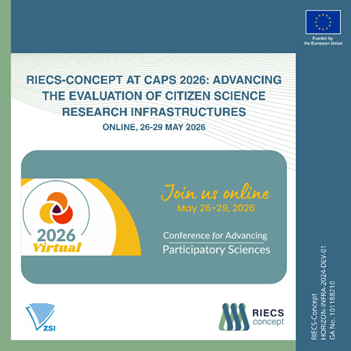
📢 The RIECS-Concept project was pleased to contribute to the 2026 Conference of the Association for Advancing Participatory Sciences (CAPS), one of the leading international events dedicated to citizen science and participatory research❗
✅ During Session 8 – Individual Presentations, Dr Barbara Kieslinger, Senior Scientist and Project Coordinator at the Centre for Social Innovation (ZSI), presented the draft RIECS-Concept evaluation and impact assessment framework – an important milestone in the development of a future European Research Infrastructure for Citizen Science.

Building the Foundations for a Research Infrastructure for Citizen Science
✅ Research infrastructures play a vital role in supporting scientific excellence by providing the facilities, services, data, expertise, and networks that enable researchers and innovators to work together. The RIECS-Concept project takes this concept one step further by exploring what a dedicated Research Infrastructure for Citizen Science should look like.
✅ Unlike many traditional research infrastructures, a citizen science infrastructure places people at its core. Citizens are not only users of the infrastructure but also contributors, collaborators, and co-creators of knowledge. This participatory nature introduces new opportunities – as well as new challenges – for governance, sustainability, and evaluation.
📌 The RIECS-Concept project is working to:
⚫Assess the feasibility of establishing a pan-European Research Infrastructure for Citizen Science.
⚫Develop a strategic roadmap for its long-term governance and sustainability.
⚫Co-design the infrastructure through an open and participatory process involving stakeholders from science, policy, technology, and society.

Why Evaluation Matters
✳️ As the concept for the future infrastructure develops, robust evaluation becomes essential. Existing research infrastructures are commonly assessed through scientific excellence and implementation criteria. However, these approaches do not fully capture the distinctive characteristics of citizen science.
✳️ The framework presented at CAPS 2026 addresses this gap by proposing an evaluation and impact assessment approach specifically designed for a Research Infrastructure for Citizen Science.
✳️ The framework recognises that impact extends beyond scientific outputs to include participation, collaboration, knowledge sharing, capacity building, and societal engagement.
✨ By integrating these dimensions, the framework aims to provide a comprehensive basis for assessing the future infrastructure’s effectiveness, value, and long-term contribution to research and society ✨

Sharing Ideas with the Global Citizen Science Community
✳️ Presenting the draft framework at CAPS 2026 provided an excellent opportunity to engage with the international participatory sciences community, gather feedback from researchers and practitioners, and discuss how evaluation approaches can better reflect the unique nature of citizen science.
✳️ The insights exchanged during the conference will help further refine the framework as the RIECS-Concept project continues to develop the foundations for a sustainable and impactful European Research Infrastructure for Citizen Science.
✨ We thank all participants for the discussions and look forward to continuing the conversation as the project progresses ✨
Published 2026-07-01